Chinese Lantern Festival
Learn about the history,traditions,customs and cultural meaning of the traditional Chinese Lantern Festival.





The China Lantern Festival is one of the most recognizable traditional celebrations associated with Chinese culture. From traditional lantern displays and family customs to spectacular modern light festivals, the celebration brings together history, art, food, storytelling and community.
Explore China Lantern Festival Explore Chinese Lantern Festival
When people search for the China Lantern Festival, they may be looking for several connected ideas: the traditional Chinese festival commonly known as the Lantern Festival or Yuanxiao Festival, the many lantern celebrations held throughout China, or the spectacular large-scale lantern events that have become popular in cities and cultural destinations around the world.
All of these meanings are connected by the central role of lanterns in Chinese culture. For centuries, lanterns have represented light, celebration, hope, reunion and the arrival of a new stage in the lunar year. In modern China, the tradition has developed into a wide range of celebrations, from small community gatherings to enormous illuminated festivals featuring hundreds of artistic lantern installations.
This guide explains the China Lantern Festival in detail. It explores the history of the celebration, the meaning of lanterns, traditional activities, festival food, regional celebrations, modern lantern shows and the important connection between Zigong and Chinese lantern culture.
If you are looking for a general introduction to the festival, this page provides the essential background. If you want to explore one particular aspect in greater detail, follow the related guides throughout this article.
The China Lantern Festival is a traditional celebration associated with the fifteenth day of the first month of the Chinese lunar calendar.It is commonly known in English as the Chinese Lantern Festival and is closely connected with the Yuanxiao Festival.
The festival traditionally takes place after the Chinese New Year period and is associated with the first full moon of the new lunar year.It is often regarded as an important conclusion to the New Year celebration period.
The most recognizable feature of the festival is the presence of lanterns.Families,communities and festival organizers may display lanterns in different shapes,colors and designs.Some are small traditional lanterns carried by individuals,while others are large artistic structures created for public exhibitions.
Traditional activities associated with the festival can include viewing lanterns,solving lantern riddles,eating tangyuan or yuanxiao,watching folk performances and spending time with family.The exact customs vary between regions and communities.
In modern China,the idea of a lantern festival has also expanded beyond the traditional calendar celebration.Large public events may combine lantern art with music,cultural performances,food,technology,interactive installations and nighttime entertainment.
The China Lantern Festival is a celebration of light,culture and community that connects traditional Chinese customs with the continuing development of lantern art and modern festival experiences.
The traditional China Lantern Festival takes place on the fifteenth day of the first month of the Chinese lunar calendar.Because the traditional lunar calendar and the Gregorian calendar follow different systems,the date changes each year on the international calendar.
This is why the Chinese Lantern Festival may take place on a different date in January,February or March depending on the year.
The date is important because the festival is closely associated with the first full moon of the new lunar year.The full moon has long been connected with ideas of completeness,reunion and togetherness in Chinese culture.
Many public lantern festivals may operate for a longer period than the traditional festival date.A large commercial or cultural lantern event can open for several weeks or even longer,allowing visitors to experience illuminated displays before and after the traditional Lantern Festival day.
The traditional Chinese calendar is based on lunar cycles,while the Gregorian calendar used internationally is a solar calendar.As a result,the date of the Lantern Festival moves from year to year when converted to the Gregorian calendar.
For anyone planning to visit a specific China Lantern Festival event,the most important information is the official schedule of that individual event.The traditional festival date and the operating dates of a modern lantern exhibition may not be exactly the same.
For annual information,see our guide to theChinese Lantern Festival date.
The history of the China Lantern Festival is connected with the long development of Chinese festivals,religious traditions,seasonal customs,family celebrations and the cultural importance of light.
Like many traditional festivals,the Lantern Festival has developed over a very long period of time.Its customs were influenced by different historical periods and regional traditions.The celebration that people recognize today is the result of cultural development rather than a single event created at one specific moment.
Throughout Chinese history,lanterns have been used for both practical and symbolic purposes.Before modern electric lighting,a lantern provided illumination after dark.At the same time,decorated lanterns became objects of artistic expression and important elements of celebrations.
Public displays of lanterns created opportunities for people to gather at night.Streets,temples,markets and public spaces could become places of celebration,entertainment and social interaction.
Over time,the Lantern Festival became associated with activities such as viewing lanterns,solving riddles written on lanterns and enjoying public performances.
One of the most interesting developments in Chinese lantern culture is the transformation of the lantern from a practical source of light into a cultural and artistic object.
A traditional lantern can be relatively simple.It may consist of a frame,a covering material and a light source.However,the same basic idea can be expanded into a highly complex artistic structure.
Modern lantern artists and festival designers can create animals,mythical creatures,buildings,landscapes,historical scenes and abstract forms using illuminated structures.
This development is especially visible in large-scale lantern festivals,where lanterns are no longer limited to small objects carried by individuals.Entire landscapes and large public spaces can become part of the festival experience.
Some traditional customs have remained recognizable while others have changed according to local culture and modern lifestyles.
Viewing lanterns remains central to the festival.Lantern riddles continue to be associated with the celebration.Traditional foods remain important.At the same time,modern festival visitors may also experience large illuminated installations,digital lighting effects,interactive displays and cultural performances.
This combination of continuity and change is one of the reasons the China Lantern Festival remains relevant in the modern world.
For a deeper historical overview,visit our guide to thehistory of the Chinese Lantern Festival.
Lanterns have many different meanings in Chinese culture,and the meaning of a particular lantern can depend on its color,shape,design and cultural context.
In a broad sense,light is often associated with positive ideas such as hope,celebration,guidance and the beginning of a new period.
The Lantern Festival also has a strong connection with family and reunion.The round full moon is often understood as a symbol of completeness,while the gathering of families and communities gives the celebration a strong social dimension.
Red is one of the most recognizable colors in traditional Chinese festivals.Red lanterns are widely associated with celebration,good fortune and festive occasions.
This is why red lanterns can often be seen during Chinese New Year celebrations,traditional festivals,cultural events and public decorations.
Round lanterns are especially recognizable because their shape is visually connected with the full moon and ideas of completeness.
In modern lantern festivals,however,lanterns can take almost any form.A display may include round lanterns,architectural structures,animals,flowers,mythical creatures and large narrative scenes.
A large lantern installation can communicate much more than color and light.It can tell a story.
A festival designer may use a sequence of lantern structures to represent a traditional legend,a historical story,a natural landscape or an important cultural theme.
In this way,lantern festivals can function as a form of visual storytelling.
Read more aboutwhat Chinese lanterns symbolize
The traditions associated with the China Lantern Festival vary throughout China.Different regions,families and communities may celebrate in different ways.
However,several activities are widely associated with the Chinese Lantern Festival.
Viewing lanterns is the activity most directly associated with the festival.
Traditional lantern displays may include simple handmade lanterns,decorative hanging lanterns and artistic lantern structures.Modern festivals can include large illuminated scenes covering parks,streets,gardens and public spaces.
The experience is especially powerful at night,when the lighting transforms the appearance of the lantern structures and surrounding environment.
Lantern riddles are a well-known traditional activity associated with the festival.
A riddle may be written on or displayed with a lantern,and visitors try to solve it.The riddles can involve language,history,literature,mathematics or everyday objects.
This tradition adds an intellectual and interactive element to the festival.
Food is an important part of the Lantern Festival experience.
Tangyuan and yuanxiao are commonly associated with the festival.These round foods are often connected with ideas of reunion and completeness.
Although tangyuan and yuanxiao can be similar in appearance,preparation methods and regional traditions can differ.
Depending on the region and event,Lantern Festival celebrations may include traditional performances such as dragon dances,lion dances,music,dance and other forms of folk entertainment.
Modern lantern festivals may combine these traditions with stage performances,cultural shows and contemporary entertainment.
The Lantern Festival is also a social and family celebration.
Visiting lantern displays,sharing food and spending time together are important parts of the festival experience for many families.
Explore the complete guide toChinese Lantern Festival traditions.
Chinese lanterns come in many different forms.Traditional lanterns can be small and portable,while modern festival installations can be enormous structures that require engineering,design and complex lighting systems.
Hanging lanterns are among the most recognizable forms of Chinese lantern decoration.They can be displayed in homes,streets,temples,public buildings and festival spaces.
Their design may be simple or highly decorative,depending on the occasion.
Small lanterns carried by individuals are associated with traditional celebrations and community activities.
A handheld lantern can be designed in many shapes and may include paper,fabric,bamboo,wood or other materials depending on the style.
Artistic lanterns are designed primarily for visual expression.They may represent flowers,animals,buildings,characters,landscapes or cultural symbols.
These lanterns can be displayed individually or as part of a larger themed exhibition.
Large-scale festival lanterns are among the most visually impressive developments in modern Chinese lantern art.
A large lantern may require a structural frame,multiple layers of exterior materials,decorative surfaces,electrical systems,internal access and on-site installation.
Some large installations are designed to be viewed from a distance,while others create immersive spaces that visitors can walk through.
Modern technology has created new possibilities for lantern festivals.
Lighting controls,sensors,programmable LEDs,sound systems and interactive elements can allow visitors to experience lantern displays in new ways.
Even when modern technology is used,the central concept remains the same:using light,color and form to create a visual experience.
ExploreTypes of Chinese Lanterns
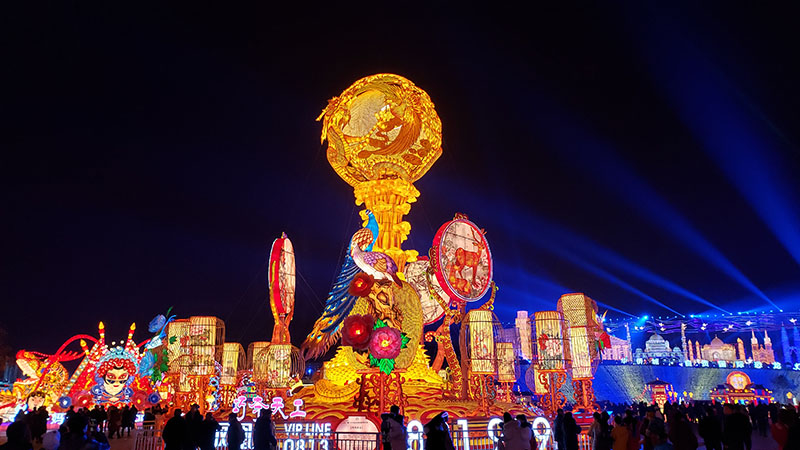
ZIGONG•SICHUAN•CHINA
Zigong has become one of the most important names associated with Chinese lantern culture and large-scale lantern festivals.
The city is known for a distinctive lantern tradition that combines artistic design,structural construction,decorative craftsmanship and modern lighting technology.
This combination allows lantern designers and craftsmen to create large visual installations that can communicate stories,cultural themes and artistic ideas through light.
Zigong's relationship with lantern culture is particularly important to the development of modern China Lantern Festival events.
The city is often associated with the transformation of lantern making from small decorative objects into large-scale public art installations.
A modern lantern festival may look very different from a traditional lantern display, but the underlying principles remain connected.
Both rely on the relationship between structure, surface, color and light.
The difference is scale and complexity.
A small traditional lantern may be made for personal use or local decoration. A large festival installation may require a design team, structural specialists, craftsmen, electricians, transportation planning and an installation crew.
This development has allowed Zigong lantern art to become increasingly visible in large public festivals and international cultural events.
Learn more about the Zigong Lantern Festival and the history of Zigong lantern culture.
The production of a large Chinese festival lantern is a combination of design, structural work, decorative craftsmanship and lighting installation.
The exact process varies depending on the size, materials, design and intended location of the lantern.
Every major lantern installation begins with an idea.
The design concept may be based on a traditional story, an animal, a mythical creature, a natural landscape, a historical subject or a modern theme.
Designers consider the intended audience, location, viewing distance and relationship between different lantern structures.
Sketches, illustrations and three-dimensional models can be used to develop the appearance of the lantern.
At this stage, designers consider proportions, colors, lighting effects and the way visitors will see the installation.
Large lanterns require an internal structure capable of supporting the shape and exterior materials.
A steel or other structural framework may be created according to the design.
The structure must be appropriate for the size and intended installation environment.
After the framework is completed, craftsmen create the outer shape of the lantern.
This stage can involve shaping, covering, forming and preparing the surface for decoration.
Color and surface details give the lantern its visual identity.
Decorative elements may include painted details, fabric surfaces, patterns, textures and other artistic components.
Lighting is central to the final appearance of a lantern festival installation.
LED systems can be used to create different colors, brightness levels and lighting effects.
Some installations may use programmed lighting sequences or interactive technology.
Large lanterns may be assembled, tested and prepared before being installed at the final festival location.
Transportation and on-site installation can be significant parts of a large lantern project.
The completed display must be visually effective while also being appropriate for the conditions of the festival environment.
Read our detailed guide to how Chinese lanterns are made .
The China Lantern Festival is not celebrated in exactly the same way everywhere.
Different regions have their own traditions, local foods, cultural performances, lantern designs and public celebrations.
Some festivals focus primarily on traditional customs. Others have developed into major public events featuring large-scale lantern displays, cultural performances and modern entertainment.
Historic cities can provide an especially strong setting for lantern festivals.
Traditional architecture, old streets, temples, gardens and cultural landmarks can become part of the nighttime festival environment.
Lanterns can change the visual character of these spaces, creating a connection between historical surroundings and contemporary festival design.
Modern cities may host lantern events in parks, exhibition spaces, commercial districts and large public venues.
These events can include large illuminated structures, cultural themes, food areas, entertainment and interactive experiences.
A lantern festival can reflect the culture of the region where it is held.
Local stories, natural landscapes, historical figures, traditional architecture and regional artistic styles can all influence the design of lantern displays.
This is one reason why China Lantern Festival events can be very different from one city to another.
Explore more about Lantern Festival celebrations in China .
Modern lantern festivals continue to evolve.
Traditional lantern craftsmanship remains important, but modern events increasingly combine lantern art with new technologies and new approaches to visitor experience.
One of the most important developments is the combination of traditional lantern design with modern lighting technology.
Programmable LED systems can create changing colors and sequences. Sensors can allow interactive responses. Digital systems can synchronize lighting with music or other elements of the festival.
These technologies do not necessarily replace traditional craftsmanship. Instead, they can expand the possibilities of what a lantern installation can do.
Modern visitors often expect more than a static display.
Large lantern festivals may therefore be designed as complete nighttime experiences.
Visitors can walk through themed areas, enter illuminated structures, view large-scale scenes, take photographs and experience different combinations of light, sound and movement.
Modern lantern festivals can also provide a way to communicate cultural stories to international audiences.
A visual scene can introduce a traditional legend, a historical event, a natural landscape or an aspect of Chinese culture without requiring visitors to already understand the subject.
This makes lantern festivals especially suitable for international cultural events.
As public events develop, organizers are also increasingly interested in the practical aspects of festival production, including energy consumption, material selection, transportation, installation and the reuse or recycling of components.
The future of large-scale lantern festivals will likely involve continued development in both artistic design and responsible event planning.
Chinese lantern culture is no longer limited to festivals held within China.
Large lantern exhibitions and Chinese cultural light festivals have been presented in many international locations.
These events can introduce audiences to Chinese art, stories, traditions and visual culture through an accessible nighttime experience.
Light is a universal visual language.
Visitors do not need detailed knowledge of Chinese history to appreciate a large illuminated sculpture or colorful lantern display.
At the same time, the themes behind the displays can provide an opportunity to learn about Chinese culture.
International lantern festivals can present traditional Chinese stories through visual scenes.
Dragons, phoenixes, animals, landscapes, historical characters, traditional buildings and mythical stories can all become part of a festival design.
This combination of entertainment and cultural storytelling is one reason why Chinese-style lantern festivals have become popular in international events.
Zigong has played an important role in the development of large-scale Chinese lantern art and its international visibility.
The city's lantern tradition demonstrates how a local cultural craft can develop into an international form of artistic and cultural exchange.
For organizations planning a cultural light event,understanding the relationship between traditional Chinese lantern design and modern festival production is essential.
Every festival is different,but a modern China Lantern Festival may include several types of experiences.
Visitors may encounter large lantern structures representing animals,mythical creatures,architecture,landscapes or cultural themes.
Smaller traditional lanterns can provide a connection to the historical origins of lantern culture.
Music,dance and folk performances may be included depending on the festival program.
Festival food and local cultural activities can become an important part of the visitor experience.
Some modern festivals use lighting technology and interactive systems to create more immersive environments.
The visual nature of illuminated lantern displays makes them popular destinations for nighttime tourism and photography.
People sometimes use the expressions“China Lantern Festival”and“Chinese Lantern Festival”interchangeably.In everyday English,both can refer to the traditional festival associated with lantern displays and the Yuanxiao Festival.
However,there is a small difference in how the expressions may be understood.
| Expression | Common Meaning | Typical Search Intent |
|---|---|---|
| China Lantern Festival | A lantern festival or lantern festival culture associated with China. | Events,China,cultural festivals and lantern displays. |
| Chinese Lantern Festival | The traditional Chinese festival commonly associated with the Yuanxiao Festival. | History,date,traditions,meaning and cultural customs. |
In this guide,the phrase China Lantern Festival is used broadly to discuss lantern festival culture and celebrations in China,while Chinese Lantern Festival is used when discussing the traditional cultural festival itself.
For a detailed explanation of the traditional festival,visit ourcomplete Chinese Lantern Festival guide.